Laundering Money Through a Non‑Profit That Generates Revenue from Underprivileged Children: Why It Should Be a Crime

Nonprofit organizations play a critical role in supporting underprivileged children by providing essential services, including meals, education, health care, and social support. Donors and governments allocate billions annually to charities with the expectation that funds will reach intended beneficiaries. When these organizations are used instead as conduits for money laundering or personal enrichment, the harms are profound, affecting children, families, donors, and public confidence in civil society.

Although money laundering is already criminalized at federal and state levels, exploiting nonprofits serving vulnerable children should be treated as an aggravated offense, with specific statutory language and enhanced penalties. The need for such criminalization has become evident through recent investigations and charges in states such as Florida.

Background: Money Laundering and Nonprofits

Money laundering generally involves disguising the origins of unlawfully obtained funds to make them appear legitimate (U.S. Department of Justice [DOJ], 2025). Traditional anti‑money laundering statutes target financial institutions and commercial entities, but nonprofit organizations can be equally vulnerable to abuse. Unethical organizational leaders may use nonprofits’ tax‑exempt status, complex financial networks, and public goodwill to “clean” illicit proceeds.

When a nonprofit purports to serve underprivileged children, the ethical breach is particularly severe: the façade of charity is used to access funds targeted for those who lack financial or political power. As a result, lawmakers, prosecutors, and advocates have increasingly scrutinized these abuses.

Florida Examples of Nonprofit Abuse

Center for Special Needs Trust Administration (CSNT)

A stark illustration of nonprofit exploitation occurred in Florida involving the Center for Special Needs Trust Administration (CSNT). Federal authorities unsealed an indictment charging two Florida men with multiple crimes, including conspiracy to commit money laundering related to the misappropriation of more than $100 million from a nonprofit that managed trust funds for people with special needs (Govoni & Witeck case). The defendants allegedly siphoned funds meant to support disabled beneficiaries and used complex financial transactions to conceal the theft (Department of Justice, 2025; see also Fox 13 News, 2025). Numerous trust accounts, many serving vulnerable children, were partially or fully drained, undermining the very purpose of the nonprofit (Fox 13 News, 2025; DOJ, 2025).

This case underscores how the misuse of nonprofit structures for personal enrichment can devastate populations the charities are meant to protect, especially children and individuals with disabilities.

Rayfield School of Excellence Case

Another example involved a Florida nonprofit participating in a state‑funded program to provide meals for children. The nonprofit’s director was charged with over-billing the State of Florida for summer meals, defrauding state funds of more than $2.8 million and misapplying nonprofit revenue for personal benefit (Office of the Attorney General, 2023). Although not explicitly about laundering money through a children’s charity, this case demonstrates how nonprofit funds intended for underprivileged children can be misdirected for individual gain, a behavior that should be subject to enhanced scrutiny and criminal penalties.

Why Exploiting Nonprofits Serving Children Should Be a Specific Crime

Aggravated Harm to Vulnerable Populations

Fraud and money laundering involving charities already violate existing law, yet the moral and social harms are magnified when children are the ostensible beneficiaries. Children lack the capacity to advocate for themselves, making it easier for unscrupulous actors to conceal abuse. Enhanced statutes that recognize the exploitation of children‑focused nonprofits as an aggravated offense would reflect societal condemnation of this conduct.

Deterrence and Public Trust

Clearer criminal categories with enhanced penalties for laundering money through nonprofits that serve children would send a strong deterrent message. Public trust in charitable institutions is essential for philanthropy and community engagement; repeated abuses risk eroding donor confidence and defunding legitimate services.

Strengthening Accountability for Nonprofit Boards

A nonprofit board of directors holds a legally defined fiduciary duty to exercise oversight, protect organizational integrity, and ensure compliance with applicable laws and ethical standards. When boards are ineffective, tolerate bribery, overlook illegal activity to satisfy leadership, ignore sexual harassment complaints, or fail to safeguard funds intended for mission-related purposes, they jeopardize both the organization and those it serves. Under Florida law, nonprofit directors and officers are generally shielded from civil liability when acting in good faith and in the best interests of the organization (Fla. Stat. § 617.0834, 2024), but this immunity does not extend to actions involving criminal conduct, bad faith, or breaches of duty such as self-dealing and willful disregard of legal obligations (Fla. Stat. § 617.0834, 2024; Fla. Stat. § 617.0830, 2025). Governance failures, including ignoring sexual harassment and mismanagement of funds, can expose boards to lawsuits from employees, beneficiaries, donors, and state regulators, including the state attorney general, for breaches of fiduciary duty or wrongful acts (ASAE-AON, 2025; Nonprofit Risk Management Center, 2025). When board members actively condone illegal conduct or fail to intervene despite clear red flags, they should not only be subject to civil liability but also criminal prosecution where appropriate and barred from serving on any nonprofit board in the future to prevent further harm to vulnerable populations and to uphold public trust in the charitable sector (Nonprofit Risk Management Center, 2025). Enhanced statutory provisions and enforcement mechanisms that explicitly address aggravated misconduct by nonprofit boards would reinforce accountability and ensure that serving on a board reflects a commitment to ethical stewardship and legal compliance.

Facilitating Prosecution and Restitution

Specific criminal provisions can help prosecutors pursue cases more efficiently and secure restitution for victims. In cases like CSNT’s, where complex financial manipulation and concealment are involved, distinct statutory language focused on child‑serving nonprofits would aid in framing charges that align with the public harm caused.

Policy Recommendations

  1. Enact Enhanced Criminal Statutes: State and federal legislatures should clarify that laundering or misappropriating funds from nonprofits serving underprivileged children constitutes an aggravated crime with significant penalties beyond general fraud or money laundering statutes.
  2. Strengthen Oversight and Transparency: Require regular public audits and disclosure of financial activities for nonprofits serving children and other vulnerable populations to identify red flags early.
  3. Promote Whistleblower Protections: Safeguard employees, volunteers, and beneficiaries who raise concerns about financial irregularities in charities.
  4. Interagency Collaboration: Improve cooperation between charity regulators (e.g., IRS, state attorney general offices) and criminal investigators to detect and act on abuses involving nonprofits.

While existing money laundering and fraud laws provide a framework to prosecute financial abuse and deception, they do not sufficiently address the unique harms caused when nonprofit organizations meant to serve underprivileged children are used for illicit financial gain. Recent cases in Florida, such as the CSNT trust misappropriation and other nonprofit fraud schemes, reveal the need for legal frameworks that specifically criminalize the laundering of money through child‑serving charities. By enacting targeted statutes, strengthening oversight, and enhancing penalties, policymakers can better protect vulnerable populations and uphold the integrity of the nonprofit sector.

References

Associated Press. (2025, April 28). Hope Florida: A timeline of how a DeSantis‑backed state charity was accused of wrongdoing. WESH. (WESH)

Department of Justice. (2025, June 23). Florida nonprofit founder and accountant charged with stealing over $100M from special needs victims. U.S. DOJ Press Release. (Department of Justice)

Fox 13 News. (2025). Pinellas businessman accused of stealing $100M from special needs trusts indicted on federal charges. (fox13news.com)

Office of the Attorney General. (2023, June). Attorney General’s office charges nonprofit director for stealing nearly $3 million. Florida Legal. (myfloridalegal.com)

A Reassessment of the Recall Effort Targeting Mayor Daniella Levine Cava

By Sharron L. Henley, MA, MIN, Journalist and Radio Personality

Mayor Daniella Levine Cava delivering the State of the County address. Miami-Dade County, 2021.

A recent report by NBC 6 South Florida (2025a) described the recall campaign against Miami-Dade County Mayor Daniella Levine Cava as stemming from broad public dissatisfaction. This framing, however, oversimplifies the motivations behind the recall effort and fails to account for the substantive accomplishments of her administration. A more comprehensive evaluation reveals significant progress across economic development, housing, environmental sustainability, transit, and government modernization areas that directly affect the quality of life for county residents.

Economic Initiatives and Tax Relief

Levine Cava’s administration has prioritized small-business growth and post-pandemic economic recovery. The STRIVE305 program, for example, now supports approximately 15,000 small businesses across the county (The Floridian, 2025a). Additionally, the county expanded non-tax revenue sources, including naming-rights partnerships, to strengthen fiscal stability during challenging economic periods (The Floridian, 2025a).

The mayor also oversaw two consecutive property-tax reductions, resulting in the lowest combined county tax rate since 1982 (Miami-Dade County, 2025). These measures provided direct financial relief for homeowners and contributed to broader economic stability.

Affordable Housing and Tenant Support

Affordable housing has been among the administration’s central priorities. Since taking office, Levine Cava has doubled the county’s affordable-housing investment, funding more than 5,000 new units, with roughly 8,000 additional units in development (The Floridian, 2024). Her administration also established the Office of Housing Advocacy, which offers mediation, landlord–tenant support, eviction-prevention services, and financial guidance for residents struggling with housing costs (The Floridian, 2024). These strategies reflect a holistic approach that addresses both housing supply and resident stability.

Transit and Mobility Improvements

Levine Cava has promoted mobility improvements through the county’s SMART transit program aimed at increasing connectivity and reducing reliance on automobiles (Miami-Dade County, 2025). The launch of Metro Express, a Bus Rapid Transit (BRT) service along the South Dade corridor, represents a major milestone in expanding equitable and efficient public transportation (Axios, 2025).

Environmental Sustainability and Climate Resilience

The administration has implemented an extensive portfolio of sustainability initiatives from installing solar energy and air-conditioning improvements in public housing to electrifying the county vehicle fleet and increasing energy efficiency in public facilities (The Floridian, 2025b). Significant progress has also been made in environmental protection, including septic-to-sewer conversions aimed at improving water quality in Biscayne Bay (The Floridian, 2025b).

To promote long-term resilience and innovation, Levine Cava established the Miami-Dade Innovation Authority (MDIA), which funds companies developing solutions for regional challenges such as sargassum accumulation, infrastructure strain, and traffic management (The Floridian, 2025a).

Government Modernization and Public Accountability

The administration adopted a “No Wrong Door” policy, emphasizing accessible and user-friendly services for residents (Miami-Dade County, 2025). Under Levine Cava’s leadership, county departments earned 151 national awards recognizing excellence in service delivery, fiscal efficiency, and administrative performance (Hoodline, 2025). These achievements indicate ongoing improvements in transparency, responsiveness, and government effectiveness.

Limitations of the Recall Narrative

Although the recall campaign, as reported by NBC 6 South Florida (2025a), highlights constituent concerns, including issues related to local infrastructure, flooding, and public services, these criticisms represent only one dimension of a complex administrative landscape. While no local government can fully avoid operational challenges, the recall campaign risks reducing the mayor’s comprehensive record to isolated frustrations. For many residents, long-term gains in housing, economic stability, environmental protection, and transportation may outweigh the administrative shortcomings emphasized by recall advocates.

An oversimplified recall narrative may also threaten continuity in policy areas that require long-term planning and multi-year implementation. Abrupt leadership changes can undermine progress on housing development, transit expansion, and climate resilience initiatives that depend on stability and multi-agency coordination.


Toward a Balanced Public Evaluation

A more constructive public discussion should situate both achievements and shortcomings within a broader context. Residents would benefit from:

  1. Objective evaluation of outcomes by weighing both tangible successes and legitimate public concerns.
  2. Transparent accountability in areas where county services require improvement.
  3. Inclusive community engagement that supports informed decision-making rather than reactive political mobilization.

Mayor Daniella Levine Cava has guided Miami-Dade County through a period marked by economic recovery, housing pressures, environmental threats, and demographic change. Her administration has delivered measurable improvements in economic support services, housing investment, sustainability planning, and government effectiveness.

Although public dissatisfaction captured in recall reporting is valid in some respects, it presents an incomplete picture of her leadership. A more balanced assessment suggests that the county may benefit not from abrupt political turnover but from continued accountability paired with policy continuity.


References

  • Axios. (2025). Miami-Dade’s express bus service launches Oct. 27.
  • Hoodline. (2025). Miami-Dade County shines with 151 achievement awards from National Association of Counties.
  • Miami-Dade County. (2025). Promises kept, progress made.
  • NBC 6 South Florida. (2025a). Effort underway to hold recall election to remove Miami-Dade mayor from office.
  • NBC 6 South Florida. (2025b). Miami-Dade mayor responds to recall effort saying she’s served “very well”.
  • The Floridian. (2024). Miami-Dade County Mayor Daniella Levine Cava details her work on improving affordable housing.
  • The Floridian. (2025a). Cava highlights economic accomplishments in first term as mayor.
  • The Floridian. (2025b). Miami-Dade County Mayor Daniella Levine Cava addresses climate efforts, sustainability after first term.

Questions or Comments: shenley@cwcnews.org

Tune in every Sunday 12N ET Conversations With Charito on Excitement Radio http://www.excitementradio.com

Should Miami-Dade County Public Schools include self-defense instruction for K-12 Curriculum to Combat Bullying?

Brielle Archellus, a sixth-grade honor roll student from Liberty City, Florida faced classroom bullying. Her parents encouraged her to share her experience in an interview to encourage others to stand against bullying. Archellus was determined to tell her side of the story and give advice to other school-aged children.

Interview with Brielle Archellus

During the interview, a quiet, shy, and beautiful melanin-skinned young girl entered the building and nervously shuffled her feet under the table while adjusting her microphone. Then, in a soft-spoken voice, she said, “Hi, my name is Brielle Archellus, and today we are going to talk about bullying.” Archellus, while describing the bullying incident, nervously expressing how it was making her feel, brought her anti-bullying message to life.

“I just don’t understand why they want to bully someone; I just want to go to school and get good grades so that my mom and dad will be proud of me,” said Archellus. 

“Sometimes people have problems at home that they don’t want to talk about. My mom, dad and brothers love me. They show me that they care. Sometimes kids don’t have that, so they get mad at you because you are happy. I’m not going to let them make me mad all the time, but I’m not going to let anybody just keep hitting me,” said Archellus.

The bullying incident that Brielle experienced is a prime example of why a self-defense K-12 Curriculum to combat bullying is vital in the local school district. 

Self-defense classes, such as martial arts or karate, are usually offered by private companies or provided through an advocate diversion program after a person becomes a victim of bullying or the aggressor. 

However, fees and costs associated with participation or certification of the classes mentioned above may pose a problem for minorities residing in low socio-economic areas in urban school districts, like Miami-Dade County Public Schools (M-DCPS). They have limited incomes or are receiving public assistance on a fixed income.

M-DCPS is the largest school district in Florida, and the third largest district in the nation. A diverse population of minorities, from low-income to middle income, with more than 35,000 employees, 340,000 K-12 students, inclusive of Title I Schools; whereas Title I provides federal funding to support effective, evidence-based educational strategies that close the achievement gap and enable the students to meet the state’s challenging academic standards. (M-DCPS Statistical Highlights 2019-2021).

The current Florida Statute 1006.147, adopted due to a bullying suicide, became law, known as Jeffrey Johnston Stand Up for All Students Act requires school districts in Florida to adopt an official policy prohibiting bullying and harassment of students.

“Providing evidence-based instruction that promotes preventive self-defense while incorporating character building, conflict resolution, and social-emotional skills, will decrease the number of victims affected by bullying and deter bullying in K-12 educational settings in Florida.” (Gage, Lee, et, al 2019) explained that utilizing the School Wide Positive Behavior Interventions and Supports program solely may not have a long-term effect, but by integrating evidence-based bullying prevention and intervention programs has the probability of producing positive outcomes with anti-bullying and behavioral bullying.

PSA:Stop Bullying with Jamari Bell

In an interview with Jamari Bell, featured in the “Stop Bullying” PSA, Bell shared his perspective and personal experience regarding a recent bullying incident. “I didn’t do anything to him.  I am new to the school, and he thought that he could push me around. The first time it happened to me, I didn’t tell the teacher or my mom. He was bigger than me, but I wasn’t afraid to tell the teacher. I just wanted to handle it myself, so he would not bother me anymore,” said Bell.

“Bullying is not right, because they could hurt people’s feelings. It’s not nice to bully. Being a bully is not good because it can make people commit suicide. I think schools should have classes for people who get bullied and people who bully people so they could learn how to stop bullying,” said Bell. 

“When people bully other people, sometimes that makes them commit suicide, and I don’t think that they should bully people,” said Bell.  

Jamari’s mother, Mahoghaney Bell, expressed her concern about the way the principal handled the incident. “The principal called the school police on my son, and he was the victim. They need to do better with children that are victims of bullying,” said Bell.

#BullyingFacts

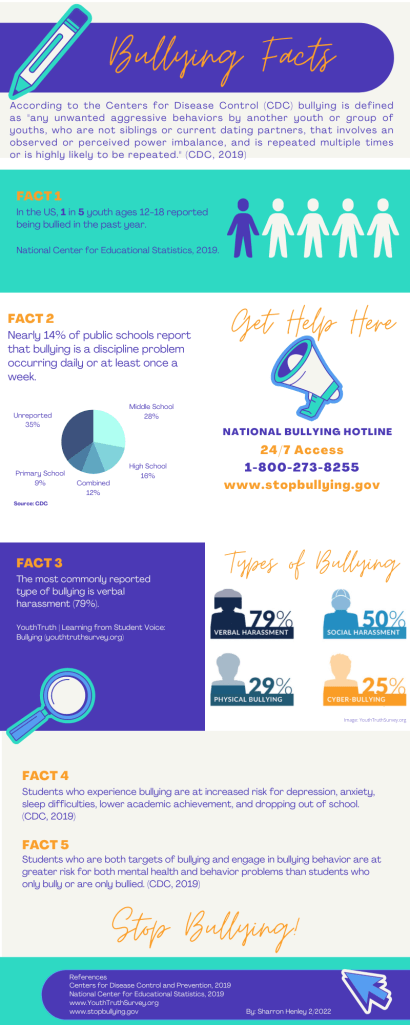
According to the CDC (2019), “1 in 5 youth ages 12-18 reported being bullied in the past year”. Victims of bullying may endure name calling, threats, and intimidation over an extended period, while many incidents go unreported out of fear or embarrassment.

Information provided by the CDC in the research pamphlet The Relationship Between Bullying and Suicide: What We Know and What it Means for Schools developed in 2014 to respond to problems of bullying and suicide-related behavior concluded the following:

“The bottom-line of the most current research findings is that being involved in bullying in any way—as a person who bullies, a person who is bullied, or a person who both bullies and is bullied (bully-victim)—is ONE of several important risk factors that appears to increase the risk of suicide among youth.” 

According to the CDC (2019), “Students who experience bullying are at an increased risk for depression, anxiety, sleep difficulties, lower academic achievement, and dropping out of school.

Interview with Anthony Harris, Dean of Students

In an interview with Anthony Harris, Dean of Students, known for his raspy voice, at Excelsior Charter Prep Academy, of Miami-Dade County Public Schools, also known as Coach Harris, proudly discussing his anniversary of serving as a disciplinarian, mentor and coach to impressionable youth in urban areas of South Florida, showing considerable concern regarding the notifications of recent threats, and possible weapons on several campuses across the local school district.

“In the past 17 years I’ve served over 12,000 students, many whom were either victims or aggressors of bullying. However, most students, whether they’re victims or aggressors, don’t realize they’re bullying someone, on and off social media.  This is behavior is not tolerated in the school district or at my school sites,” said Harris.

As a former athlete, Harris reluctantly recalls using bullying tactics, a common practice during his adolescent years, to members of the opposing team in high school. Harris recalls seeing the effects of bullying in his hometown community of Ft. Myers, Florida.

Overwhelming outcomes and experiences of becoming a college student, adjusting to changing behaviors as a professional athlete, transitioning to an NFL player, became a life changing decision for Harris to improve and expand his community involvement efforts to save troubled youth in urban school districts, experiencing bullying.

During the interview, Harris stated that, “Students should be able to come to school without worrying about bullying, gangs or illegal drugs on campus.”

“Students oftentimes become used to the behaviors of bullying, as victims, they become reluctant to report the incidents for fear of retaliation, but we have a zero tolerance for bullying, threats of school violence, or any other at-risk behaviors at our schools,” said Harris.

“Serving as a Dean of Students comes with an array of responsibilities, but first and foremost it is my responsibility to create a safe environment where the teachers can teach without distractions and the students can learn without distractions. I am only one individual, I believe that a curriculum focused on bullying prevention, delivered as a required course during school hours, would be beneficial, since after-school programs concentrate on sports, intervention should occur before they get on the field, just like the NFL,” said Harris.

In an interview, Lynda Roberts North Miami Beach Police Department Athletic League (PAL) and Florida State-Wide PAL Coordinator, discussed the importance of providing enrichment and prevention activities for youth ages 13-18.

 “Offering a safe environment and cultural enrichment activities provides a diversion for bullying. When youth are engaged in meaningful and stimulating activities, they don’t have time for bullying. To show the seriousness of bullying in schools, it is worth putting some statistics into perspective,” said Roberts.

According to the U.S. Department of Justice, Bureau of Justice Statistics, School Crime Supplement (SCS) to the National Crime Victimization Survey (2019) “In 2019, about 22 percent of students ages 12–18 reported being bullied at school during the school year, which was lower than the percentage reported in 2009 (28 percent). In 2019, about 16 percent of students in grades 9–12 reported being electronically bullied during the previous 12 months.” 

“Our job is to protect and serve as law enforcement officials, but we also have to consider the fact that some bullying incidents end in school shootings and homicides. We have to ensure that the youth served in our programs receive bullying prevention education to prevent incidents from occurring in our schools,” said Roberts.

“An innocent life lost to senseless gun violence is never acceptable to any family member.  No one ever reaches a level of understanding, they only seek closure and someone to be convicted or take responsibility in the loss of their loved one, especially if it was caused by bullying, which can be prevented,” said Roberts.

“Youth enrolled in our Police Athletic Leagues across the state of Florida have a better opportunity in becoming productive citizens in our communities through prevention efforts and programs, designed to deter youth from at-risk behaviors,” said Roberts.

Roberts continued by saying, “PAL programs across the state of Florida continue to work tirelessly, and collaboratively with local school districts, social service organizations, and law enforcement groups, to deter at-risk youth behaviors.  We have more work to do, if we plan on eradicating the effects of bullying on youth and their future.”

In an interview with Garry Graham owner of Graham Counseling & Consulting, LLC from New York, a licensed mental health counselor and therapist, he discussed counseling services for a few adults who were victims of bullying.

Interview with Garry Graham, Mental Health Counselor

 “About 35% of the adults that I work with were bullied in their childhood, the remaining percentages possibly never admitted their experience, due to embarrassment. Those who have been bullied experience depression, or even feeling inadequate, or less of a person,” said Graham.

According to Sandee LaMotte of CNN adults serving as bullies, are the likely victims of childhood bullying, troubling childhood experiences, and adolescent bullying.

Based on a study in the Journal of Child and Family Studies by Ellen DeLara of Syracuse University, the need for expanded research by health care providers, supporting the impact of childhood bullying, and the effects of behaviors lasting into adult life is essential.

“A lot of people like to think that you have to put anti-bullying information in a K-12 curriculum. That’s the easy part. The identifying and most important marker for me is to identify the bully,” said Graham.

For more information on suicide prevention, call the National Suicide Prevention Lifeline at 1-800-273-8255 (TALK) or visit http://www.stopbullying.gov

Click on the link for updates and additional information on collaborative partnerships with United Teachers of Dade in support of “Should Miami-Dade County Public Schools include self-defense instruction for K-12 Curriculum to Combat Bullying?”

Click on the link below to view or download a copy of “Should Miami-Dade County Public Schools include self-defense instruction for K-12 Curriculum to Combat Bullying?” by Sharron L. Henley (2022)

Dean of Students discusses concerns about bullying and weapons on campus in Miami-Dade County Public Schools

Sharron Charito Henley interviews Anthony Harris, Dean of Students for Excelsior Charter Prep Academy

As the 2021 Holiday Season approaches, students and teachers are preparing for an extended holiday break filled with celebrations and family gatherings. However, the recent school threats and social media threats are putting a damper on the joyous holiday season.

According to NBC Miami three students are facing felony charges for making deadly threats on social media against a local high school at Miami-Dade County Public Schools.

In an interview with Anthony Harris, Dean of Students, known for his raspy voice, at Excelsior Charter Prep Academy, of Miami-Dade County Public Schools, also known as Coach Harris, proudly discussing his 17 year anniversary of serving as a disciplinarian, mentor and coach to impressionable youth in urban areas of South Florida, showing considerable concern regarding the notifications of recent threats, and possible weapons found on several campuses across the local school district.

“In the past 17 years I’ve served over 12,000 students, many whom were either victims or aggressors of bullying. However, most students, whether they’re victims or aggressors, don’t realize they’re actually bullying someone, on and off social media.  This is behavior is not tolerated in the school district or at my school sites”, said Harris.

As a former athlete Harris reluctantly recalls using bullying tactics, a common practice during his adolescent years, to members of the opposing team in high school. Harris recalls seeing the effects of bullying on others, leading into their adult careers and professional lives, in his hometown community of Ft. Myers, Florida.

Overwhelming outcomes and experiences of becoming a college student, adjusting to changing behaviors as a professional athlete, transitioning to an NFL player, became a life changing decision for Harris to improve and expand his community involvement efforts to save troubled youth in urban school districts, experiencing bullying, potential suicide as a victim of bullying.

According to a CNN article adults serving as perpetrators of bullying, are most likely victims of childhood bullying, troubling childhood experiences and adolescent bullying.

Similarly, deLara’s article Consequences of Childhood Bullying on Mental Health and Relationships for Young Adults describes the need for expanded research by health care providers to continue supporting the impact of childhood bullying and the effects of the behaviors lasting into adult life.

Harris suffering an injury as an NFL Player  in 2003 decided to use his talents and experience of self-control on the football field to assisting, training and developing youth off the field in education, to deter youth from at-risk behaviors. He began volunteering as a mentor for local school districts, providing crime prevention and self-esteem building activities coupled with sporting events at no cost to youth in South Florida.

During the interview Harris stated that, “Students should be able to come to school without worrying about bullying, gangs or illegal drugs on campus”.

“Students oftentimes become used to the behaviors of bullying, as victims, they become reluctant to report the incidents for fear of retaliation, but we have a zero tolerance for bullying, threats of school violence, or any other at-risk behaviors at our schools”, said Harris.

“Serving as a Dean of Students comes with an array of responsibilities, but first and foremost it is my responsibility to create a safe environment where the teachers can teach without distractions and the students can learn without distractions”, said Harris.

This story involves details of bullying. If you need additional assistance, please visit https://www.stopbullying.gov/

Resources

deLara, E. W. (2019). Consequences of Childhood Bullying on Mental Health and Relationships for Young Adults. Journal of Child & Family Studies, 28(9), 2379–2389. https://doi.org/10.1007/s10826-018-1197-y